Students are already using AI
Whether educational institutions plan for it or not, students in schools, colleges and universities are already using tools such as ChatGPT, Claude and Gemini. They use them to answer homework questions, write essays, summarize readings and solve problems.
Most of them have never been taught how these tools work, where they go wrong, or how to use them responsibly. Many simply copy answers. Others avoid AI completely because they think it is cheating. Neither group is being prepared for the world they are about to enter. That is why AI training for students has become one of the most important investments an educational institution can make.
Why AI training for students should start early
1. AI is becoming a basic skill
Reading, writing and basic computer skills were once the foundation for every career. AI literacy is joining that list. Employers in every sector, from banking to healthcare to media, now expect graduates to know how to work with AI tools productively. Students who learn this early enter university and the job market with a clear head start.
2. The right habits are easier to build early
Habits formed at school age tend to stay. A student who learns early to question AI answers, check facts and use AI to understand a topic, rather than to skip the thinking, will carry that approach into university and work. A student who learns to copy and paste will carry that habit too.
3. AI can make learning deeper, not shallower
Used well, AI is a patient tutor. It can explain a difficult concept in different ways, generate practice questions, give feedback on a draft, and help a student explore a topic they are curious about. Used badly, it replaces the effort that learning requires. The difference comes down to training.
4. Students need to understand the risks
AI tools can produce confident answers that are wrong. They can reflect bias, and they raise real questions about privacy and academic honesty. Students should know how to spot errors, protect their personal information and use AI ethically, so these lessons come before mistakes, not after them.
5. It builds the next generation of builders
Early exposure does more than create good users. It sparks interest in how AI works. Students who build a simple chatbot, automate a small task or train a basic model at school are more likely to choose careers in technology, data and AI. For countries across South Asia and the Middle East, this is how a strong local AI talent pipeline begins.
The goal is not to teach students to depend on AI. It is to teach them to think with it, question it and build with it.
Why the right AI knowledge matters
Not all AI education is equal. A one-off session full of tips and tricks, or a list of the latest apps, does not prepare students for anything. Tools change every few months. What lasts is understanding.
The right AI knowledge for students includes:
- How AI works in simple terms: what a model is, how it learns from data, and why it can be wrong.
- Reasoning and problem solving: breaking a problem down, giving clear instructions and judging the result.
- Critical thinking: checking sources, comparing answers and recognizing bias.
- Responsible use: academic honesty, privacy and the ethical questions AI raises.
- Creating, not just consuming: using AI to build projects, not only to answer questions.
Why practical exposure is essential
AI is a practical skill, much like learning a language or a sport. Students learn it by doing, not by listening to a lecture about it. Good programs give students hands-on work such as:
- Using AI to research and plan a project, then checking every fact it provides.
- Writing and improving prompts, and seeing how small changes affect the answer.
- Building a simple chatbot or automation for a real problem at their educational institution.
- Presenting what they built and explaining where AI helped and where it failed.
This kind of practical exposure builds confidence. Students stop seeing AI as magic or as a threat, and start seeing it as a tool they control.
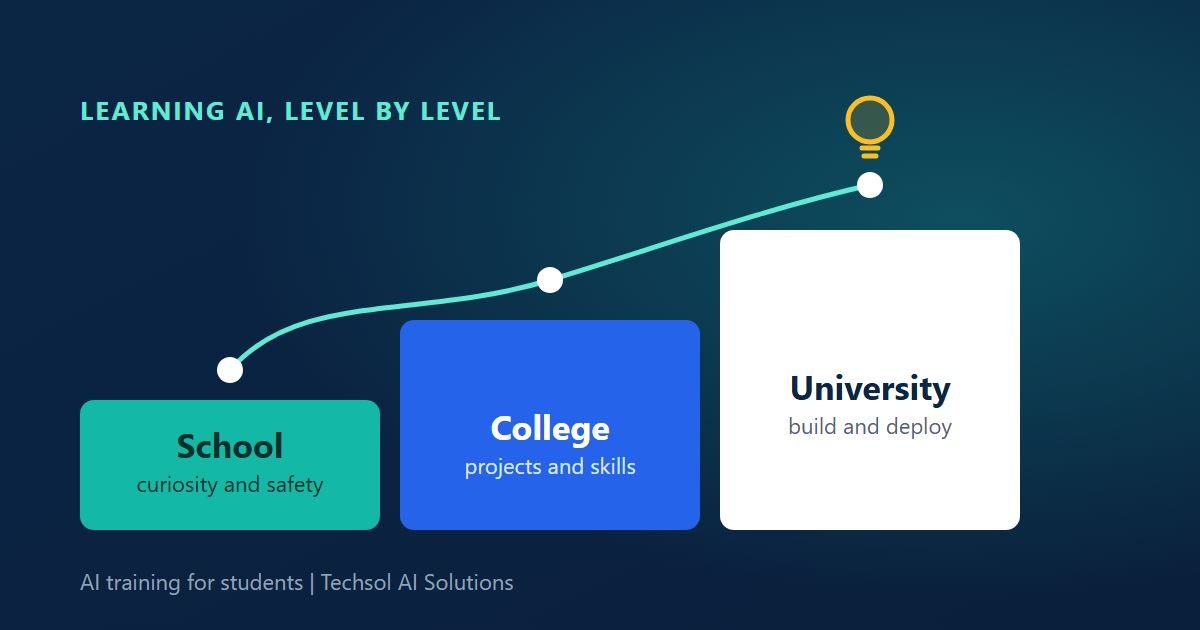
What this looks like at each level
School students
Focus on curiosity, safety and reasoning: what AI is, how to ask good questions, how to check answers, and simple creative projects.
College students
Focus on applying AI to study and early career skills: research, writing support, data handling, presentations and small build projects.
University students
Focus on professional and subject-specific use: AI in their field of study, automation, AI agents, and real projects that can go into a portfolio before graduation.
Teachers come first
Students learn AI best from teachers who are confident with it. That is why effective programs train teachers alongside students, so they can use AI in lesson planning, assessment and classroom activities, and guide students with authority rather than fear.
How Techsol AI Solutions supports educational institutions
Our academic AI training includes hands-on teacher training workshops, after-school student programs, and level-by-level Reasoning and AI courses. Every program is practical: students and teachers build, test and question AI, rather than just hear about it. Because our trainers also build AI solutions for organizations, students learn how AI is actually used at work.
Key takeaways
- Students are already using AI. Training decides whether they use it well.
- Starting early builds the right habits, critical thinking and confidence.
- The right AI knowledge focuses on understanding and responsible use, not passing trends.
- Practical, hands-on exposure is what turns students into capable AI users and future builders.