Everyone is an AI trainer now
Demand for corporate AI training has grown faster than the number of people qualified to deliver it. Social media is full of AI experts, and workshops promising "50 prompts that will change your life" are everywhere. Many of these trainers are engaging speakers. They know the latest tools and can run an entertaining session.
But there is an important question every organization should ask before booking a trainer: has this person ever built and deployed an AI solution that a real business depends on?
Two kinds of AI trainers
The performer
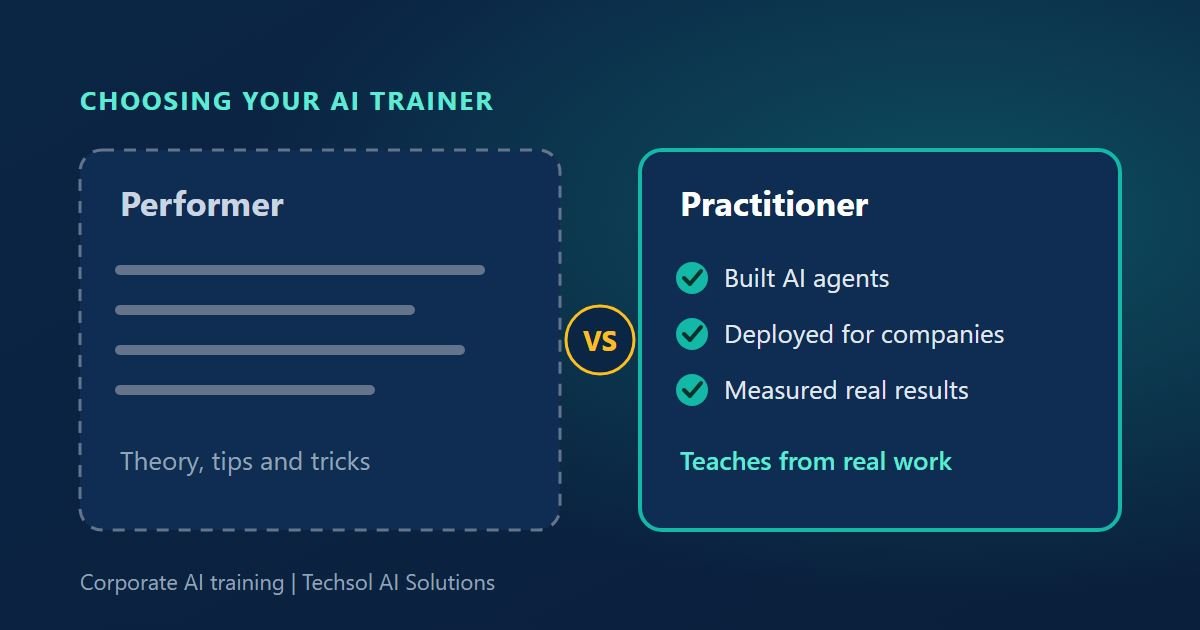
The performer delivers polished sessions built around theory, trending tools and tips and tricks. Participants enjoy the session and leave with a list of prompts. A few weeks later, very little has changed in how they work, because the content was never connected to their actual processes, data or systems.
The practitioner
The practitioner has designed, built and deployed AI solutions for companies: AI agents, automations, voice agents and dashboards that run every day. They have dealt with messy data, demanding clients, security questions, budgets and users who resist change. When they teach, they teach from that experience.
A performer can tell your team what AI can do. A practitioner can show your team how to make AI do it in your organization.
How practitioner-led training is different
1. It starts with your work, not with the tools
Practitioners begin by understanding your processes: where time is lost, where errors happen, and what decisions slow people down. The training is then built around those real tasks, so participants practise on work they will do on Monday morning.
2. It covers what happens after the demo
Anyone can show a prompt that works once. Practitioners teach what makes AI work reliably: structuring context, checking outputs, handling exceptions, protecting sensitive data and controlling token costs. These lessons only come from deploying AI in real conditions.
3. It is honest about limits
Practitioners know where AI fails, because they have seen it fail in production. They help teams avoid wasted effort on ideas that look good in a demo but break at scale, and they can explain clearly when AI is the wrong tool.
4. It produces results, not just inspiration
Practitioner-led programs end with working outputs: an automated report, a team assistant, a documented workflow, or a plan to deploy. Success is measured in hours saved and processes improved, not in session feedback scores.
5. It connects training to solutions
When a trainer also builds solutions, the path from learning to implementation is short. Ideas that come up in a workshop can become real projects, with the same people who taught the session able to help build them.
Signs you are dealing with a performer
- The agenda is a list of tools and prompt tricks, with nothing about your processes.
- Examples are generic, such as writing a poem or planning a holiday, rather than drawn from your industry.
- The trainer cannot describe a single AI system they have built and deployed.
- There are no hands-on exercises using your real tasks and data types.
- Nothing is measured after the session.
Questions to ask before you hire an AI trainer
- Which AI solutions have you personally built or deployed for companies?
- Can you share before and after results from that work?
- How will you tailor the program to our processes and roles?
- What will participants be able to do, or have built, by the end?
- How do you cover data security, accuracy checks and cost control?
- What support is available after the training to put it into practice?
Why practitioner-led corporate AI training matters for leaders
AI training is an investment of budget and, more importantly, of your people's time. Training led by performers often creates a short burst of enthusiasm and then fades. Training led by practitioners changes how work is done, because it is grounded in how AI is actually delivered inside organizations.
For C-suite leaders, practitioner experience is even more important. Decisions about AI strategy, governance, risk and return on investment need guidance from people who have seen projects succeed and fail, not from people who have only read about them.
The Techsol AI Solutions approach
At Techsol AI Solutions, our trainers are practitioners. The same team that delivers our AI training programs designs and deploys our AI solutions, from AI agents and voice agents to automation and dashboards. Since 2020 we have delivered more than 500 projects and trained more than 1,000 people, and every program is built around the participants' real work, with hands-on practice and measurable outcomes. See the results in our case studies.
Key takeaways
- Many AI trainers share theory and tips. Far fewer have built real AI solutions.
- Practitioner-led training starts from your processes and ends with working results.
- Real deployment experience teaches reliability, limits, security and cost control.
- Before hiring a trainer, ask what they have built, not just what they have taught.