
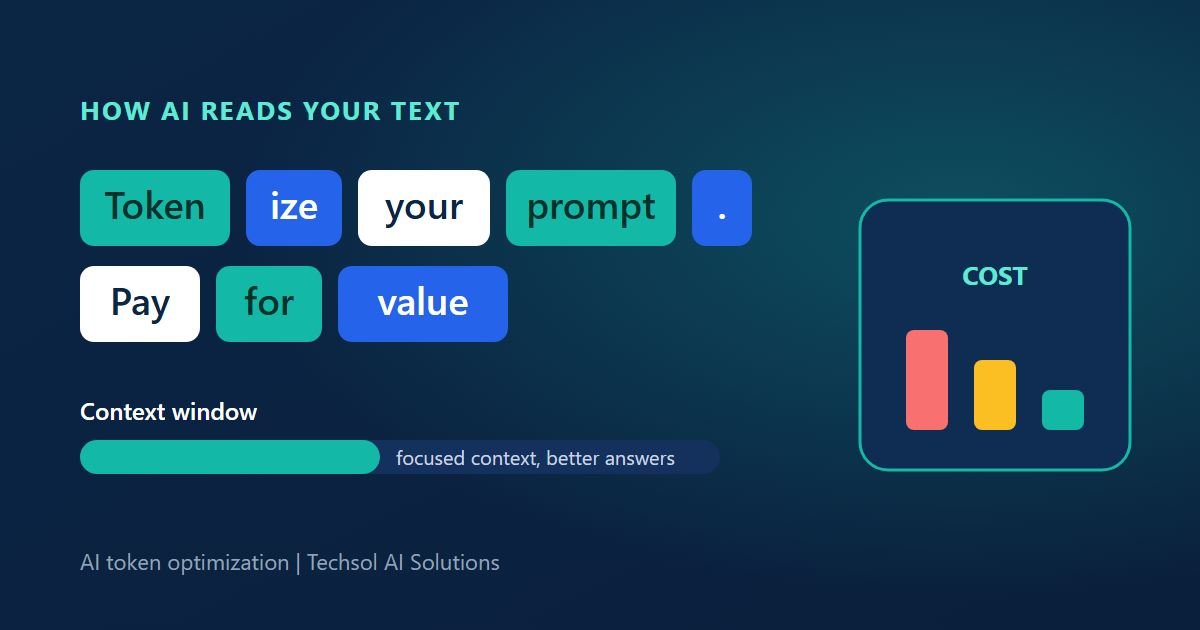
What is tokenization in AI?
Large language models such as ChatGPT and Claude do not read words the way people do. Before a model can work with your text, it breaks that text into small pieces called tokens. This process is called tokenization, and managing it well, known as AI token optimization, is now a core skill for any team that uses AI.
A token can be a whole word, part of a word, a number, or a punctuation mark. As a rough guide, one token is about four characters of English text, so 1,000 tokens is roughly 750 words. Other languages, code, tables and long numbers often need more tokens for the same amount of meaning.
Everything the model handles is counted in tokens: your instructions, the documents you paste in, the chat history it remembers, and the answer it writes back. That count decides three things that matter to every business using AI: cost, speed and quality.
Why tokens matter more than most teams realize
1. Tokens are what you pay for
AI platforms and APIs charge by the token, usually with one price for input tokens and a higher price for output tokens. A single long prompt may cost very little. The same prompt sent thousands of times a day by an AI agent, a customer support bot or a whole department adds up quickly. Teams that never look at their token usage are often surprised by their monthly AI bill.
2. Tokens decide how fast you get an answer
The more tokens a model has to read and write, the longer it takes. For a chat window this is a few seconds of waiting. For an AI voice agent on a live call, or an automation processing thousands of records, extra tokens mean slower service and frustrated customers.
3. Too many tokens can lower quality
Every model has a context window, the maximum number of tokens it can consider at once. Filling that window with long, unfocused material does not make the model smarter. Important instructions get buried, the model loses track of what matters, and answers become vague or inconsistent. More context is not the same as better context.
Optimal token usage is not about using AI less. It is about giving the model exactly what it needs, so you get better answers, faster, at a lower cost.
Common ways organizations waste tokens
- Pasting whole documents when only one section is relevant to the question.
- Endless chat threads where every new message carries the full history of an old conversation that no longer matters.
- Vague prompts that lead to long, generic answers, followed by several rounds of corrections.
- Using the largest model for every task, even simple ones such as sorting emails or extracting a date.
- Asking for long outputs by default when a table, a list or a short summary would do.
- Agents and automations with no limits, which can loop, retry and call tools far more often than needed.
AI token optimization: practical habits for using tokens carefully
- Be specific. State the task, the audience, the format and the length you want. A clear prompt usually gets the right answer the first time.
- Send only relevant context. Share the paragraph, table or file the model needs, not the whole folder.
- Start fresh conversations for new topics instead of continuing one very long thread.
- Ask for structure. Bullet points, tables and fixed formats are shorter and easier to use.
- Match the model to the task. Use smaller, faster models for routine work and keep the most capable models for complex reasoning.
- Reuse what works. Save good prompts as templates, and use features such as prompt caching where your platform offers them.
- Measure. Track token usage per team, per workflow and per agent, the same way you would track any other operating cost.
How optimal token usage gives you an advantage
Organizations that manage tokens well do not just save money. They get several advantages over competitors that treat AI as a black box:
- Lower cost per task, which makes it affordable to roll AI out to more people and more processes.
- Faster responses in customer facing tools such as chatbots and AI voice agents.
- More accurate, consistent outputs, because the model focuses on the information that matters.
- AI systems that scale, since a workflow that is efficient for ten users stays affordable for ten thousand.
- Better budgeting, because leaders can predict and explain what AI is costing and what it returns.
For leaders, token economics is now part of AI strategy. When you can show the cost of each AI workflow and the value it creates, it becomes much easier to make the case for further investment.
Tokens and AI agents
Token discipline matters most when AI works on its own. An AI agent may read files, call tools, check results and try again, many times for a single request. Without limits on context, retries and output length, a small inefficiency is repeated hundreds of times. Well designed agents keep their working context short, summarize as they go, and only load information when it is needed. This is one of the main differences between an AI demo and an AI system that runs reliably in production.
How Techsol AI Solutions helps
Tokenization and AI cost economics are part of our corporate AI training programs, from C-suite leadership sessions to hands-on workshops for functional teams and Claude Code training for developers. Participants learn to write focused prompts, structure context and manage tokens for faster, lower-cost results.
When we design and deploy AI solutions, such as AI agents, voice agents and automations, we build token efficiency in from the start, so the system stays fast and affordable as usage grows.
Key takeaways
- Tokens are the units AI models read and write, and they drive cost, speed and quality.
- More context is not always better. Focused input produces better output.
- Simple habits, such as clear prompts, relevant context and the right model for the task, cut waste quickly.
- Teams that manage tokens well can scale AI further, faster and more affordably.